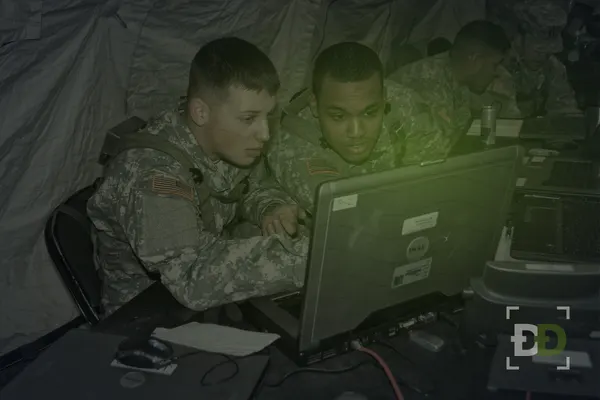
AI training jobs for cybersecurity experts pay security professionals to test AI systems, review the code AI writes and grade what AI says about threats and incidents. The companies building AI models need people who think like attackers, and general raters can’t tell when an answer about an exploit chain or a firewall rule is wrong or dangerous.
The work is remote, usually paid by the hour, and open to anyone with the experience, whether it came from a security team, a consultancy or a military cyber unit. It is one of the largest groups of remote jobs for veterans that use military skills.
Four kinds of work make up most security AI projects
Most projects fall into one of four kinds of task, and many contractors move between them as projects start and end.
Red teaming AI systems
You try to make an AI model do what it shouldn’t, within rules the project sets: give dangerous instructions, reveal hidden information, or let an AI agent take an action it was told not to. You write up each finding with what you tried, what the model did and how severe it is. The write-up is the product, because it is what the company uses to fix the model.
Reviewing code that AI writes
AI coding tools write a growing share of software, and they repeat the mistakes in the code they learned from. You read code an AI produced, find the vulnerabilities, such as injection flaws, broken authentication or unsafe memory handling, and explain the fix. These projects look for people who do secure code review for a living.
Grading answers about security
You read AI answers to security questions, about incident response, malware analysis, cloud configuration or compliance, and rate them for accuracy and safety. Where an answer falls short, you write a better one. This is the work closest to what SOC analysts and incident responders do every day.
Writing challenge tasks
Some projects pay you to write problems for AI to solve, often in the style of capture-the-flag challenges: a vulnerable service, a packet capture, a reverse engineering puzzle. A good task is one that an expert can solve and the current AI can’t, so the people who design CTFs or train junior analysts do well here.
Hands-on security experience counts more than a degree
These projects hire for what you can do, and most ask for several years of hands-on work in the field. The backgrounds that fit best:
- penetration testers and red team operators,
- SOC analysts and incident responders,
- application security engineers and secure code reviewers,
- malware analysts and reverse engineers,
- cloud and network security engineers,
- veterans of military cyber and signals units.
Military cyber experience maps directly. An Army 17C, a Navy CTN, an Air Force 1B4 or a Marine in the 17-series did the same work these projects describe, often at a higher tempo than a civilian team. Describe it in civilian terms, as penetration testing, network defense or incident response, and leave out anything classified. The guide to putting military experience on a civilian resume covers how.
A degree in computer science helps with code review projects, but few projects require one.
Certifications help, and projects name the ones they want
A certification proves your level to a screener who can’t watch you work. The ones AI security projects name most often:
| Certification | What it shows | Fits |
|---|---|---|
| OSCP and other Offensive Security certifications | You can break into systems in a hands-on exam | Red teaming, challenge writing |
| CISSP | Broad security knowledge and at least five years of paid experience | Grading answers, policy and compliance tasks |
| GIAC certifications, such as GPEN, GCIH or GREM | Depth in one specialty, from penetration testing to malware analysis | The matching specialty |
| CompTIA Security+ | Baseline knowledge; the entry certification for many DoD cyber roles | Grading answers, entry to cleared work |
| CEH | Familiarity with attacker tools and methods | Grading answers |
If a project needs a specific certification, it says so in the job title or the requirements. Without one, experience you can describe in an interview usually carries the application. Many veterans already hold Security+ or more from the certification rules for DoD cyber work, now DoD 8140 and formerly 8570.
Most projects test your skills before the first paid task
Expect a test in your specialty, and expect it to decide most applications. Code review projects usually hand you a file and ask you to find and explain the vulnerabilities. Grading projects show you an AI answer and ask what is wrong with it. Red team projects may ask you to describe how you would approach a system, in writing, before they give you access to one.
Some platforms run an interview with an AI interviewer first, and most check your identity. Treat the test as the work itself: explain your reasoning step by step, name the risk and its severity, and say how to fix it.
You test only what the project authorizes
Red teaming an AI system is legal because its owner has authorized it, and only within the scope they set. Each project gives you rules: which models or systems you may test, what kinds of attacks are in scope and how to report what you find. Testing anything outside those rules, including the platform you work through, can break the Computer Fraud and Abuse Act in the US and similar laws elsewhere.
Three habits keep the work clean:
- Read the project’s rules before each new task, since scope changes between batches.
- Report findings only through the project’s own channel, not in public, on social media or in a write-up.
- Stop and ask the project lead when a task seems to reach past its scope.
What you find on a project belongs to the company that hired you, under the agreement you signed. A working attack on an unreleased model is the most sensitive thing you will handle, and keeping it private is a condition of the work.
Most projects pay you as a contractor
Most security AI projects hire you as an independent contractor. You choose your hours, and nobody withholds tax from your pay. In the US you report the income and pay self-employment tax yourself, often through quarterly estimated payments.
Hours depend on the project. Some let you work a few hours a week and pause for a busy stretch, and some want 20 or more hours a week and say so when you apply. That makes the work easy to fit next to a full-time security job, if your employer’s policy on outside work allows it. Projects end without much notice, so many contractors keep applications open on two or three platforms at the same time.
How to apply for a cybersecurity AI training project
- Open the cybersecurity jobs and read the requirements of two or three that match your specialty.
- Update your resume so your specialty, your years in it and your certifications appear in the first few lines.
- Practice for the test by reviewing a short piece of vulnerable code out loud, naming each flaw, its severity and its fix.
- Apply to several projects in the same week, since approval takes days and projects fill quickly.
- Keep your first weeks light, and read the rules closely, because most rejections come from missed instructions.
Analysts with an intelligence background can also look at the intelligence analyst jobs, and former operators at the military subject matter expert jobs.